.png)
In the "Bat Cave" with Thomas Bachelder

Updated: Apr 16

Thomas Bachelder has made wine all over the world. After studying winemaking in Beaune, vinifying the Lemelson Vineyards in Oregon, as well as brief work in Chile, he planted his roots in the Niagara Peninsula.
You might think you know Niagara wines. But at the LCBO, the selection from this region has long been dominated by the well-known names and handsomely lined pocketbooks of international-domestic blends and celebrity endorsed vineyards.
LCBO outlets across the province adorn the big names and bulk produced wines of the longtime capital kings. Bachelder isn’t one of those mass market wines, rather focusing on releases that are small on volumes, but big on profile.
Thomas is a man obsessed with terroir—a French word meaning how a region’s unique environmental factors like soil type, typical climate and altitude combined with human practices affect a crop’s character.
Arguably, he is a pioneer in a movement to map the sense of place in each plot of grapes within the roughly 5,500 hectares of the Niagara Peninsula VQA.
While he got his start as a home winemaker, a communications professional, and a wine journalist, Bachelder bounced between careers in his youth.
While writing for American Express Wine Society catalogues, he waited on tables at a Greek Restaurant to make ends meet. The restaurant was one of few in Quebec (his home-province), at the time, with a bring your own bottle (BYOB) program.
“Opening wines for a Greek restaurant, talking with wine clubs that would come into the restaurant because they could bring their wine. This was very rare in Quebec back in the day,” he said. “I was becoming a journalist who learned to love everything, which is cool. But pinot [noir] still had chosen me. I was most interested in Burgundy.”
He went to study in the heartland of pinot noir—the Bourgogne (Burgundy) region of France. Reminiscing of his studies at the Centre de Formation Professionnelle et de Promotion Agricole in Beaune (CFPPA), he remembers tastings in the vineyards of Bourgogne kings Henri Jayer and Bernard Morey.
While at winemaking school, Thomas went tasting in the cellar of Bernard Morey, right out of the barrels. On the docket was a collection of Bourgogne chardonnays.
To this day, he remembers many of the appellations that were in that day’s wine selection. Chassagne-Montrachet, Saint-Romain villages, Saint-Aubin, Puligny-Montrachet and Bâtard-Montrachet—classics that changed his perception of wine.
“I walked out of that cellar and a light bulb went on,“ said Bachelder. “When I learned about all these different chardonnays, it didn’t have to be my favourite, but I really understood that we could make good terroir differences.”
It seems this core memory has made a huge impact on the way he makes wine in the heart of the Niagara bench. Thomas started off in the region as a winemaker for Domaine Le Clos Jordanne, two kilometres down the road from his current operation in Beamsville, Ont.
“Le Clos Jordanne was 56 hectares (138 acres) nobody had ever vinified before. I was becoming a specialist in making young vines and learning which side of the vineyard made the most interesting things. Wherever I could, I’d go by the lay of the land,” he said. “I would do ‘block one west’ and ‘block one east’ in two different tanks.”
Blocks, which are subdivisions of a larger vineyard, have profiles often separated by factors like grape variety, soil type, vine age, or topography.

Thomas and his wife Mary started their own operation in 2009. This move gave them the free reign to map out the terroirs of the region, block by block, row by row.
Starting with cool-climate chardonnay before moving to his true love of pinot noir in the 2011 season. Then, onto the crown grape of Beaujolais, gamay with the inaugural 2016 vintage.
Many Bachelder wines are sourced from organic grapes while using wild, indigenous yeasts found naturally within the fermentation process, and are made in small batches.
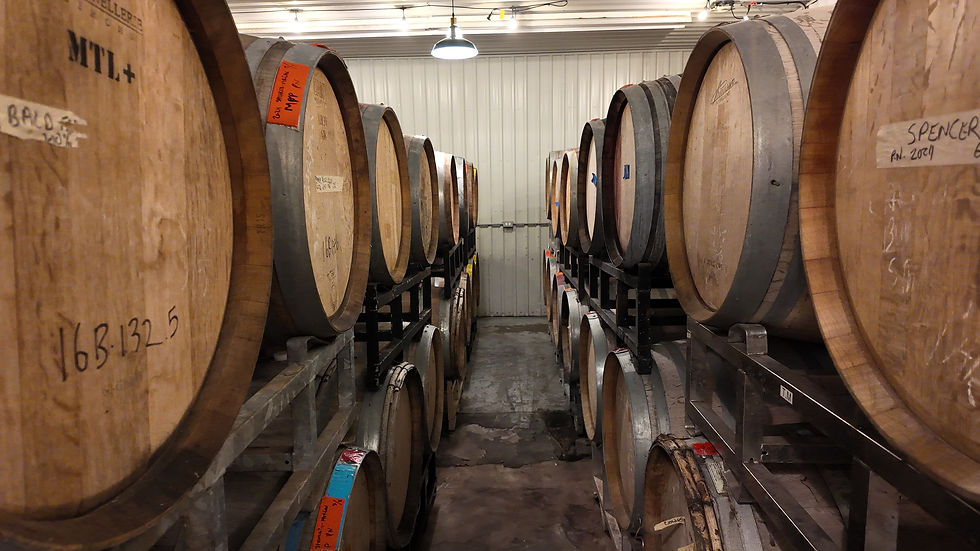
They offer small plot wines as well as “Les Villages” blends for all three varietals. Bachelder’s village blends tend to yield the most bottles. As Thomas explained, some single vineyard plots only make two to three 228 litre barrels (600 to 900 bottles total, minus loss to the process).
Thomas says his blending process is unique to every block he offers. Depending on how many grapes he receives in a given vintage, there could also be a fluctuating number of barrels for aging. Whether it be fermentation, or how much oak flavour is being absorbed by wine in a year old barrel, versus a three year old barrel, it’s a constantly changing puzzle that Thomas is putting together each vintage.
He explained part of his process using the example of his Bator Pinot Noir from 2023, which only had two barrels.
“The idea is we had two barrels of Bator. You can’t put new oak on that because if you do, you’d have 50 per cent new oak. Plus if the second barrel, the used barrel, was a little funky, and I had to declassify it into a village or there was just something I didn’t like about it, then I’d have 100 per cent new oak wine.”
Unfortunately, vines in the Bator block were ripped up in spring 2024. So get it while you can.
Thomas and Mary grow no grapes for their operation. Rather, they partner with local farmers from all across the Niagara bench and lakeshore. These days partnerships are forged through word of mouth.
Thomas usually visits vineyards in the spring, following the producers through the growing season. Of course, he is looking for the best grapes for his wine, so quality control is an aspect, but as he pointed out, ultimately it’s the grower’s vineyard.
“All you can do is not buy their grapes … I’m just watchdogging. So there’s some growers, all I have to do is go out for a beer, a glass of wine with them, or meet them up in the vineyard. They’re on autopilot. They know how to grow. They don’t need me to tell them.”
While the Niagara Peninsula VQA is only 50 kilometres wide, its of Bachelder’s belief that a wine can drastically change in colour, aroma and flavour even when just 30 metres apart.
Bachelder’s map of Niagara outlines each block from which the winery buys grapes.
Niagara-on-the-lake VQA for example is filled with lots of sand while lacking in limestone but still providing good minerality as the land was once under a thick glacier almost 50,000 years ago. Gentle landscape provides much sun by the lake, resulting in higher sugar content in the fruit.
Whereas up on the Beamsville Bench VQA, at a higher elevation, terraces filled with vines reign over the region with views of the lake and Toronto hiding in the distance. The bench adds acidity, and freshness, thanks in part to silt and from the creeks that run throughout the sloped plateau. Chardonnay see lemon zest, and fresh squeezed lime while pinot noir and gamay display bright fruit and earthy complexity.
When Bachelder started over 16 years ago, only chardonnays were produced. Today, Thomas says they offer chards from as far east as Frontier Block near Winona, Ont., to Werner York near the U.S. border west of Niagara-on-the-Lake, Ont.
Many chardonnay vineyards in the Bachelder book coexist with pinot noir.
A true reflection of Burgundy, these two noble grapes often grow together, as the cool climates and thirst for long, slow ripening periods to achieve balance and complexity.
A few years after launch, Thomas got to making wine with his favourite grape, pinot noir. But any winemaker will tell you the troubles and tribulations of this fickle grape.
Thomas says pinot noir is so good for terroir because it has thin skins, which better reflects the delicate, and sensitive surroundings from each block.

“People will tell you pinot is a minx ... pinot is a terrible thing to deal with, yada, yada—it can be those things. But because the skin is thin, unless you’re in a hotter climate or a hot year in a cool climate, you don’t get thick skin.”
The pinot’s are singled out down to the block, with names reflecting a unique designation for each label. Bachelder’s selection from the Werner family situated on York Road in Niagara-on-the-Lake, Ont. offers a true contrast of the grape at a few metres difference.
Wismer Parke is meaty, a little bit rusty. Whereas, the “Wild West End” vineyard, just 30 metres to the west provides much more fruit, a bit more acidity. Only three barrels of wild were produced in the 2023 vintage.
With the nature of small-batch wines, it’s difficult to find opportunities for 900 bottle releases to find their way into the LCBO or SAQ. But when they do, it’s great for ease of accessibility to winelovers who can’t make it down to Niagara.
At the time of writing, 217 bottles of Bachelder Les Villages Bench Pinot Noir 2023 were available in 85 stores province-wide. While the agency offers five single plot offerings across all three cool-climate varieties, the selection is always changing in the VINTAGES department.
The future is bright, fruit-forward and ultra-local. Last year, Bachelder released a pinot blanc. Thomas said the LCBO bought the whole lot of 100 cases of the 2023 selection for a VINTAGES release.
For the Bachelders, it’s not about volume, it’s about respecting the land, and respecting the delicate terroir of the diverse Niagara Escarpment.
“[Recent popularity] is 25 years of Ontario wineries getting better with nobody noticing. It’s also people like us who concentrate on terroirs and are not selling you chardonnay reserve, pinot reserve, or gamay reserve … We’re selling you a place.”


Comments